
From HDMI Stick to Every Screen
Today, ProtoModule is an HDMI stick you plug into the back of a TV. It's small, it's quiet, and it does one thing remarkably well: it gives AI a trustworthy, real-time visual companion on the biggest screen in your home.
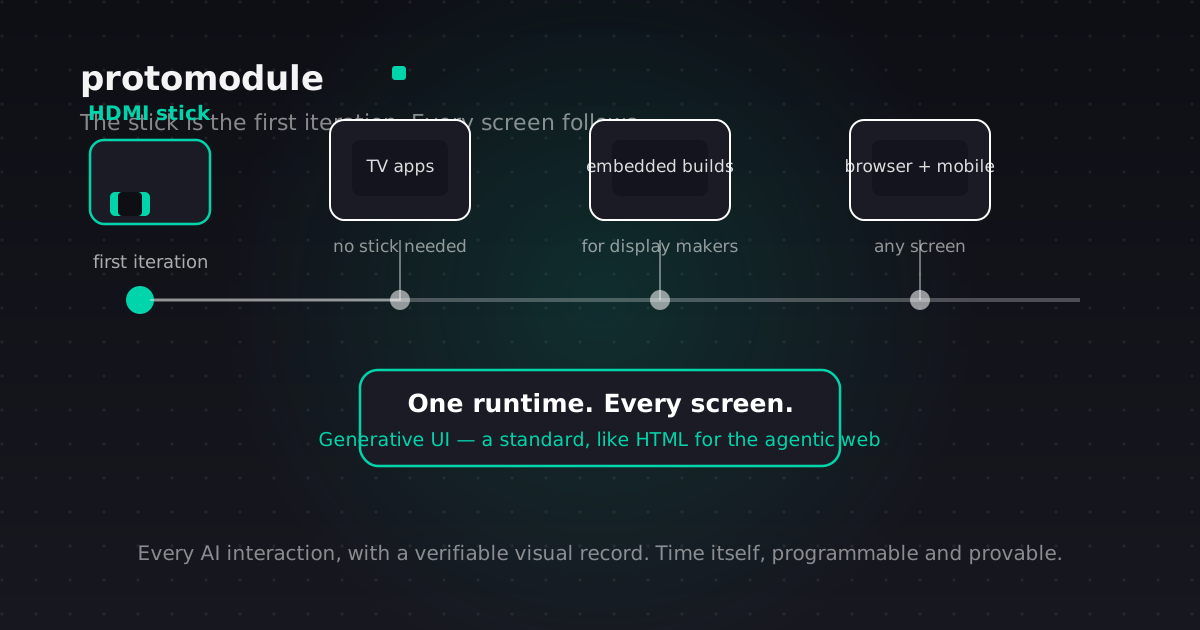
But the stick is the first iteration, not the destination. The same runtime that powers it is heading to every screen you own. The principle stays the same: agents and Missions need a real-time visual companion on the biggest available canvas. The stick proves it. The platform follows.
First: the stick proves it
Every platform starts with a proof. For ProtoModule, that proof is the stick in real households. Developers watching their agents work on a 65-inch canvas instead of a 14-inch terminal. Families who stopped fighting with technology and started using it.
This is the phase where the principle gets tested against real life. The render tools work natively with the agents people already use. The ambient dashboard becomes part of the room. The stick earns its place, one household at a time.
Then: the platform expands
Once the stick proves the principle, the same runtime spreads to every surface:
- Native TV apps. No stick needed. The runtime runs directly on the TVs people already own.
- Embedded builds. The runtime ships inside displays, built in by the manufacturers themselves.
- A browser extension. Any screen with a browser becomes a ProtoModule surface.
- A mobile app. Your phone becomes a portable canvas for your agent.
Same runtime. Same trust framework. Same provenance badges. The form factor changes; the promise doesn't. And alongside these, a marketplace grows where developers share Mission templates, so the work that took one person weeks becomes a one-tap start for everyone.
And through every form factor, the same principle holds: the runtime goes to screens you already own. No new desktop, no new tablet, no second laptop. Every expansion reuses the displays already in your life, because every new screen is a new LCD panel with a persistent chemical footprint. Reuse is not a footnote in the roadmap. It is the roadmap.
Then: the deterministic UX layer
The deeper ambition is a standard. Today, every AI product renders its own visuals, its own way, with no way to verify what you're seeing. ProtoModule's Generative UI spec changes that. It becomes the common language for trustworthy AI visuals, the way HTML became the common language for the web.
When every AI agent renders through the spec, the same frame the model analyzed is the same frame you see. Provably. In healthcare, a radiologist sees exactly what the model saw. In finance, a trader sees the same data the algorithm sees, on the same timeline. In automotive, a safety driver sees what the autonomous system perceives, frame-accurate.
The gap between what AI knows and what humans see closes to zero.
Finally: the infrastructure
At the end of the road, the runtime is everywhere. Embedded in displays, governed by a foundation, running on every screen that shows AI output. Every AI interaction has a verifiable visual record, for compliance, for audit, for trust.
Time itself becomes programmable and provable. Not a slogan, but a property of the system: every visual is deterministic, verifiable, and trustworthy, on every screen, everywhere.
Every screen that shows AI output uses the ProtoModule runtime. Every visual is deterministic, verifiable, and trustworthy.
We don't know exactly when each phase lands. We know the direction, and we know the principle holds at every step. The stick is step one. The platform is the destination. And the standard we're building toward is one where you never have to wonder whether what you're seeing is real.